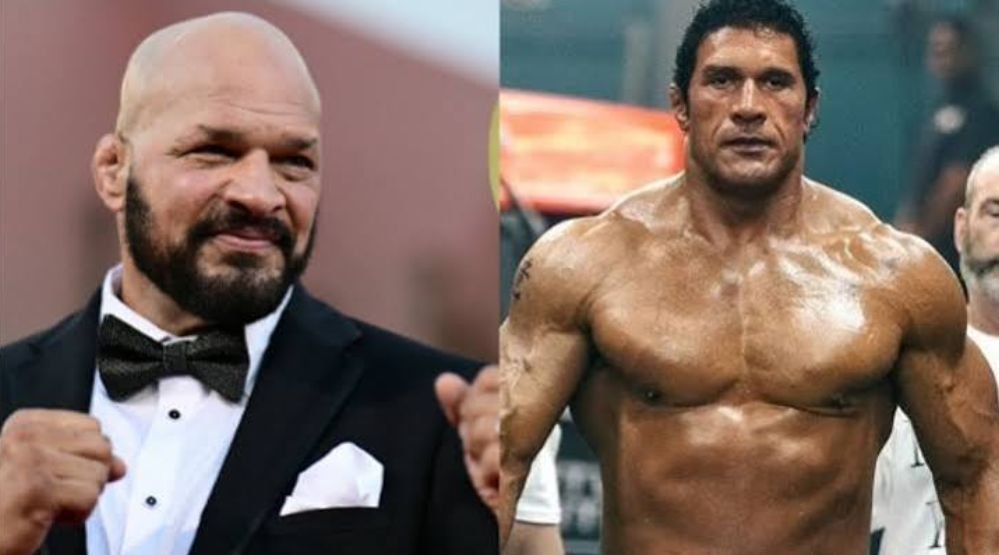
Mark Kerr: The Rise, Career, and Untold Story of the MMA Legend
Here is the thing nobody says plainly about Mark Kerr: the documentary that made him famous was also the thing that sealed how the world would understand — and misunderstand — him forever. The Smashing Machine came out in 2002, and from that moment forward, the man became the story. Not his extraordinary athletic resume, not the specific circumstances of an industry that handed out opioids like they were post-fight Gatorade, not even the decade of fighting that followed the documentary’s release. Just the addict in the Arizona house, asking for pills, crying in the gym, and loving a woman he couldn’t quite reach. That’s the frame. And now a hundred-million-dollar movie starring Dwayne Johnson is reinforcing that frame with prosthetics and a Silver Lion from Venice, and most of the people watching have no idea who Mark Kerr actually was before the cameras arrived.
Quick Bio
| Detail | Info |
| Born | December 21, 1968, Toledo, Ohio |
| High school | Toledo Waite — Ohio Division I state wrestling champion, 1986 |
| College | Syracuse University — NCAA Division I champion (190 lbs), 1992; 3x EIWA conference champion |
| Olympic qualifying | Lost to Kurt Angle at 1996 Olympic Trials; mother Mary Kerr died of cancer, September 1996 |
| MMA debut | January 1997, World Vale Tudo Championship 3 |
| UFC record | Won UFC 14 and UFC 15 heavyweight tournaments; 10-4 combined UFC/PRIDE record in his prime |
| ADCC | Four-time world champion in submission grappling, 1999–2001 |
| Documentary | The Smashing Machine, dir. John Hyams, premiered HBO May 2002 |
| Peak ranking | #1-2 in world heavyweight MMA, 1997–1999 |
| Career end | 2009, final fight at M-1 Global |
| Post-career | Real estate license 2008; personal training; car sales; GoFundMe for peripheral neuropathy, 2019 |
| UFC Hall of Fame | Inducted June 26, 2025, Pioneer Era Wing |
| Film | The Smashing Machine (A24/HBO Max), dir. Benny Safdie, released October 3, 2025 |
The Man Before the Machine
You have to go back to Toledo to understand any of this. Mark Kerr didn’t grow up near wrestling; he grew up inside it. His father Thomas was a former U.S. amateur boxing champion. Mark started competing at Bettendorf High School in Iowa — where he shared a wrestling room with a senior named Pat Miletich, who would later win a UFC title of his own — before moving back to Toledo and becoming an Ohio state champion at 175 pounds in 1986.
At Syracuse, he won three EIWA conference titles and the 1992 NCAA Division I championship at 190 pounds, beating Randy Couture of Oklahoma State in the final. That’s Randy Couture — who went on to become a five-time UFC champion and one of the most celebrated fighters in MMA history. Kerr beat him in college. That’s the level we’re talking about.
Then came the freestyle wrestling years, and this is where the story gets complicated in ways the movie doesn’t have time to address. In 1993 and 1994, Kerr was the winner of the USA Wrestling World Team Trials. He won silver and gold at the World Cup. He finished seventh at the 1993 World Championships. He was, by any measurable standard, one of the best wrestlers in the United States through most of the early 1990s. And he still couldn’t make the Olympics, because the one man standing between him and Atlanta was Kurt Angle — who would go on to win gold in Atlanta despite a broken neck, and who is now a WWE Hall of Famer. That specific rivalry, Kerr vs. Angle, is the hinge point of this whole story, and it barely gets a line in most profiles.
Let’s be honest about what the Olympic Trials loss meant. It wasn’t just losing a competition. It was the end of a four-year post-college training regimen, built around one specific goal that Kurt Angle got instead. His mother died of cancer that same September. He walked away from the pinnacle of a sport he had spent over a decade pursuing, at 27 years old, with no clear path forward and the sport’s financial infrastructure offering him essentially nothing. The U.S. didn’t pay wrestlers. There were no salaries, no pension, no support system for the people who competed at the highest amateur level and didn’t make the Olympic team. He had been living at the Foxcatcher facility in Pennsylvania, training alongside the people who would make history and those who would die in it — John du Pont shot Dave Schultz at Foxcatcher in January 1996, just months before Mark’s final Olympic bid.
This context matters because the coverage almost always starts with him already in MMA, already famous, already showing the first signs of a problem. You don’t get the full scope of what he was walking away from, and why someone might start using pills in that environment.
See also “George VI: The King Who Led Britain Through World War II“
What Actually Made Him Famous (and It Wasn’t What You Think)
The nickname “The Smashing Machine” came from a Brazilian magazine called Tatame, which gave him that title after he destroyed three opponents in one night at a Vale Tudo event in Brazil in January 1997. The moment was the beginning of everything. He was 28, he was enormous — around 250-275 pounds at fight time — and he moved through that tournament like he was clearing furniture out of a burning room.
He made $20,000 that night in Brazil, which was a significant sum in those days and a revelation for a man who had been competing at an elite amateur level without real money for years. Look at that number and understand what it meant to him. The UFC was the logical next destination, and he won the heavyweight tournaments at UFC 14 and UFC 15 back-to-back in 1997, going undefeated through a gauntlet of opponents and establishing himself as arguably the most dangerous man in a newly legitimized but still-chaotic sport.
The PRIDE years followed, and here is where the record gets interesting and underexamined. Everyone focuses on the losses — Vovchanchyn, Fujita, Herring — but the wins in PRIDE were against genuinely credentialed opposition. He submitted Nobuhiko Takada. He beat Hugo Duarte by TKO. And simultaneously, in submission grappling’s equivalent of the Olympics — the ADCC World Championships — he was winning absolutely everything in sight. Four ADCC titles between 1999 and 2001, including the absolute division and the superfight championship. Let me say that again: while his MMA career was allegedly cratering under the weight of addiction, he was winning every major grappling competition on the planet.
That contradiction doesn’t get enough attention. The standard narrative treats 1999-2001 as pure collapse. The ADCC record complicates that cleanly. He could still perform, still dominate, in specific controlled contexts. The chaos wasn’t uniform.

The Steroid Question Nobody Likes Sitting With
Sherdog’s historical breakdown of the era calls Kerr “another standard example of an underachiever” and makes a specific point worth examining: Kerr and Mark Coleman had wrestled at the same weight class — 190 pounds — in college. By the time they were fighting in the UFC and PRIDE, Kerr was competing at around 275 pounds with reportedly five percent body fat. Coleman, a bigger man by many accounts, was in the 230-range. The Sherdog analysis points out flatly that the size difference wasn’t natural development — it was steroids, and that the steroid use was contributing to Kerr’s poor cardiovascular performance in later fights.
Kerr himself has acknowledged the steroid use. He mentioned to LowKick MMA that he could “review the footage and identify nearly everyone who was involved” during that time.He talked about liver enzyme levels. He talked about the long-term damage. What he hasn’t done, and what the documentary didn’t do and what the movie doesn’t do, is sit with what it meant that an entire era of MMA was built on a pharmaceutical foundation that the sport didn’t test for, didn’t regulate, and actively benefited from in terms of spectacle and revenue.
This is not a personal failing. It was an industry standard. The early UFC and PRIDE were explicitly designed around physical spectacle — massive men destroying each other in largely unregulated conditions. The organizations profiting from that spectacle had zero interest in understanding what those men were putting into their bodies to achieve the required size. Kerr wasn’t the exception; he was a visible example of the rule. The difference is that the documentary caught him in the middle of the personal consequences.
The Vovchanchyn Fight and Why It Matters More Than The Loss
The September 1999 fight at PRIDE 7 against Igor Vovchanchyn deserves more examination than the scoreboard gives it. Vovchanchyn was on a 33-fight win streak. He was one of the most feared men in heavyweight MMA, a Ukrainian striker with almost incomprehensible endurance and a record that read like fiction. The Kerr-Vovchanchyn fight was the best heavyweight matchup MMA could offer in 1999.
After 15 minutes of grinding warfare — much of it with the heavier Kerr pressing on Vovchanchyn — the Ukrainian escaped and landed a knee to the head. Kerr went down. Vovchanchyn was declared the winner. Then PRIDE reviewed the footage and ruled the knee illegal, changing the result to a no-contest.
A technical no-contest doesn’t change what fighting Vovchanchyn for 15 minutes does to a person psychologically. The documentary captures this. What it doesn’t quite capture is that this no-contest fight — this non-loss — is often cited in the historical record as the beginning of Kerr’s decline. The result was technically a draw. His psychological response to it was not. He had come into that fight already using, already managing chronic pain, and the experience of being hurt by Vovchanchyn after fifteen minutes of dominance apparently broke something that the official record doesn’t show breaking.
The rematch at PRIDE 12 three months later — a fight Kerr entered significantly more compromised — ended in a decisive decision loss. Then came Heath Herring at PRIDE 15. And then years of sporadic fighting, each defeat arriving in the first round, each one adding to a record that looks catastrophic on a spreadsheet but carries very specific context about the body and mind behind it.
The Documentary’s Frame and What It Left Out
Look at what John Hyams’s 2002 documentary actually captures, and then look at what it doesn’t. It shows Kerr using, Kerr withdrawing, Kerr in the hospital after an overdose in October 1999, Kerr in a deteriorating relationship with Dawn Staples, Kerr crying, Kerr being talked off the ledge before fights. It concludes with a wedding in Vegas and what seems like a delicate hope.
What it doesn’t show is everything that came before 1999. The NCAA championship. The World Cup medals. The ADCC dominance. The four years of Olympic training that ended with a second-place finish to Kurt Angle. The documentary starts with the problem, not the person. And that framing — problem-first, person-second — has defined how the public understands Kerr for over twenty years.
It’s also worth noting that Dawn Staples herself was a recovering alcoholic at the time of filming, and that their relationship was two people with active addiction issues trying to anchor each other. The documentary captures the chaos of that honestly but doesn’t quite give it the structural context it deserves. When Bas Rutten tells Kerr to leave Dawn, he’s offering a trainer’s pragmatic read on what’s disrupting training camp. That’s a different question from what was actually happening between those two people, which was genuinely more complicated than “girlfriend is bad for career.”

The Decade Nobody Talks About
Between the last fight of the documentary’s story and the 2025 movie premiere lies roughly 25 years. In those 25 years, almost nothing of Mark Kerr has appeared in any mainstream outlet. He fought occasionally, always lost in the first round, and retired from competition in 2009 at 41, ending on an M-1 Global card. He got an Arizona real estate license in 2008. He tried personal training. He worked at a Toyota dealership. He took the time he needed to get sober — by his own account, that real sobriety, the emotional kind, took years longer than the physical version to achieve.
In 2019, he started a GoFundMe. Not for anything glamorous. He had peripheral neuropathy — nerve damage causing chronic pain, weakness, and numbness — and needed help managing it. The GoFundMe revealed a man who had been dealing with serious physical consequences of his fighting years largely without public attention or institutional support. The UFC didn’t fund his healthcare. No one did.
He later said the point of actual recovery was learning what he called “emotional sobriety” — the difference between not using and actually being present in your own life. That’s a harder thing to achieve and a harder thing to describe, and it doesn’t make for as clean a narrative arc as “went to rehab, got better.” The real story of the decade after the fighting is someone doing the much less cinematic work of learning to live.
Now The Rock Is Playing Him and Everyone’s Happy and I’m a Little Tired
Let me be direct about the 2025 film situation. The Smashing Machine — the Benny Safdie version, the A24/HBO Max version, the one that won a Silver Lion at Venice — is by most critical accounts a genuinely good movie. Variety called it “laceratingly humane.” BFI’s Sight & Sound gave it serious praise. Some critics had reservations about whether Dwayne Johnson could fully disappear into the emotional register the role demands, but the consensus is that it’s a serious piece of work.
What I notice is who benefits from this. Dwayne Johnson gets indie credibility and an Oscar campaign at 53. Benny Safdie gets his first solo credit on a high-profile property. A24 gets awards season oxygen. HBO Max gets a marquee title. Mark Kerr gets to stand next to The Rock at UFC Hall of Fame induction ceremonies and tell interviewers that if you took the movie away, his life is still good.
That last part is actually the most important thing he’s said in any promotion for this film. His life is still good. Not because of the movie. The movie is the epilogue to a life that was rebuilt, painstakingly, in the years nobody was watching.
My Judgment
Mark Kerr is one of the best wrestlers who ever lived who didn’t win an Olympic medal. He was arguably the most dominant force in early MMA for a window of roughly two years at the precise moment when the sport was finding its commercial footing. He had the misfortune of being filmed at his lowest point by a documentarian who did honest, important work — and that honest important work became the defining document of his public identity for over two decades. He spent twenty years rebuilding a life in the complete absence of institutional support, mainstream attention, or financial stability commensurate with what he contributed to a sport that now generates billions annually.
The 2025 film is not the redemption arc it’s being marketed as. That arc happened in real time, in Arizona, without cameras, without The Rock, and without a Silver Lion. What’s being sold now is the story of that arc, made entertaining for people who couldn’t be bothered to pay attention while it was actually happening.
He seems okay with it. He shows up to the premiere, he gives the interviews, he says he’s in disbelief. And he says if you took the movie away, his life is still good. I believe him. He earned that life. The machine they’re selling now is a version of him. The real one has been around the whole time.
FAQs
1. What happened to Mark Kerr?
He fought in early MMA through 2009, losing every fight in his final run. He then spent years working toward sobriety, held various jobs in Arizona including real estate and car sales, and has been sober for approximately seven years as of 2025. He was inducted into the UFC Hall of Fame in June 2025 and a major biopic of his life starring Dwayne Johnson was released in October 2025.
2. Why is Mark Kerr called “The Smashing Machine”?
A Brazilian wrestling publication called Tatame gave him the nickname after he demolished three opponents in a single night at a Vale Tudo tournament in Brazil in January 1997. The expression roughly means “device that crushes.” It resonated because it captured his style precisely.
3. Did Mark Kerr win a UFC championship?
Yes. He won the UFC Heavyweight Tournament at both UFC 14 and UFC 15 in 1997 — back-to-back wins that made him the most feared heavyweight on the planet for that brief window.
4. What happened at the 1996 Olympics with Mark Kerr?
He lost the Olympic Trials to Kurt Angle, who went on to win gold at Atlanta despite a broken neck. Kerr had spent four years post-college training for that specific shot. He didn’t make the team. His mother also died of cancer that September. He transitioned to MMA partly out of necessity and partly because the financial reality of elite amateur wrestling in the U.S. was essentially zero.
5. What is the 2002 documentary “The Smashing Machine” about?
Directed by John Hyams, it follows Kerr between roughly 1999 and 2001, covering his fights in PRIDE, his painkiller addiction in graphic and unflinching detail, his volatile relationship with girlfriend Dawn Staples, and the emotional collapse that accompanied his first career losses. It’s genuinely important documentary filmmaking. It’s also the lens through which most people see him, which isn’t entirely fair to what came before it.
6. Is Mark Kerr sober?
By his own account, yes. He has stated publicly that he has been sober for seven years as of 2025 — and more significantly, that he has achieved what he calls “emotional sobriety,” which took significantly longer than physical sobriety.
7. Did Mark Kerr use steroids?
He has acknowledged steroid use during his MMA career. He told LowKick MMA he could identify the steroid users from his era by watching old fight footage. He also discussed brain damage and long-term physical consequences. This was industry-wide in early MMA. Kerr is notable for being more candid about it than most.
8. Who plays Mark Kerr in the 2025 movie?
Dwayne Johnson. Emily Blunt plays Dawn Staples. The film was directed by Benny Safdie, written and edited by him as well, and won the Silver Lion at the 2025 Venice Film Festival. It opened in theaters October 3, 2025.
9. What is peripheral neuropathy and does Mark Kerr have it?
Peripheral neuropathy is nerve damage that causes chronic pain, numbness, and weakness, often in the hands and feet. Kerr revealed he had been dealing with it for years in a 2019 GoFundMe appeal. It is a known consequence of long-term physical trauma and certain substance abuse histories.
10. What is Mark Kerr’s MMA record?
15-11 with one no-contest. His best period was 1997-2000, when he went roughly 13-1-1 including his UFC tournament wins. His later career after the addiction took hold was catastrophic — he won only a handful of fights and lost virtually every late-career contest in the first round.
11. Was Mark Kerr an underachiever?
This is Sherdog’s historical verdict, and it’s partially defensible. The opposing view is that the expectations others had for him — shaped by his physical abilities and wrestling background — might have been unrealistic from the outset. He was wrestling at 190 pounds in college. He competed at 275 in MMA. The size differential was pharmaceutical, not natural, and it carried costs. The more honest framing is: he was one of the best wrestlers on earth who entered one of the most brutal, unregulated sports in history, with no support infrastructure and a sport-wide substance abuse culture, and he still achieved more than 95% of the people who ever tried.
Find fresh stories beyond the spotlight with Celebs Flare.



One Comment