
Annie Bakes: Everything to Know About the Bakery, Its Story, and Signature Treats
Here is what most coverage of Annie Bakes gets exactly backwards: the story is not that she was a troubled woman caught up in a famous man’s chaos. The story is that she was a fairly ordinary young woman from Allentown, Pennsylvania, who ended up in a situation that was genuinely dangerous, who told the truth about it on the record and in print, and who was dismissed, derided, and forgotten while the man she was describing became one of the most celebrated and mythologized athletes of the twentieth century. That’s the story. It’s not complicated. But the sports media of the 1990s — and the celebrity gossip ecosystem that followed — didn’t want to tell that one because it gets in the way of a much better narrative about a fascinating bad boy.
Let’s be honest. Dennis Rodman got to write his story. Annie Bakes got to watch him do it.
Quick Bio
| Detail | Info |
| Full name | Anicka “Annie” Bakes |
| Born | February 26, 1965, Allentown, Pennsylvania |
| Career | Model, started at 16; adult/lingerie modeling; career curtailed by 1986 car accident |
| Met Rodman | 1987, at a nightclub |
| Daughter Alexis | Born September 28, 1988 — four years before the marriage |
| Paternity suit | Filed June 1989 via palimony attorney Marvin Mitchelson, LA Superior Court; sought $7,700/month child support |
| Marriage | September 1992, lasted approximately 82 days |
| Divorce | Filed 1993; alleged abuse, STDs, forced abortions |
| Book (1997) | Worse Than He Says He Is: My Walk on the Wild Side with Dennis Rodman (also published as White Girls Don’t Bounce) |
| Chicago Tribune interview | 1997; Alexis, then 8, in anger management therapy |
| Rodman’s counter-framing | Called Bakes a “publicity-hound ex-wife” in I Should Be Dead by Now |
| Rodman’s 1993 crisis | After a divorce, he considered suicide and was discovered in a car with a loaded weapon. |
| Current life | Reportedly remarried, lives in Pennsylvania with daughter and new family |
The 1989 Document That Nobody Mentions
I want to start here because it anchors everything that follows. In June 1989, Annie Bakes — twenty-nine years old, with an eight-month-old baby — filed a paternity petition in Los Angeles Superior Court against Dennis Rodman. Her attorney was Marvin Mitchelson, who was at the time the most famous palimony lawyer in the country. She was seeking $7,700 a month in child support and argued she was entitled to at least a million dollars plus a share of Rodman’s earnings from that year’s NBA Finals between the Pistons and the Lakers.
This is the document that puts the entire story in its proper order. Annie Bakes was not, as coverage sometimes implies, a woman who drifted into Rodman’s orbit during his celebrity years and then cashed out. She was fighting in court for her daughter’s financial support while Rodman was at the peak of his championship success, while she was trying to raise an infant largely alone, and while the sports press was busy turning Dennis Rodman into an icon. The Deseret News carried a brief wire item on the filing. Nobody particularly picked it up. Rodman went on to win the championship. The story moved on.
You could stop right there and have the whole essay. But there’s more.
See also “Kris Tyson Wife: Who Is She and What You Should Know About Their Relationship“
Before Any of This, She Was Someone Else
Annie Bakes started modeling at sixteen. She was working by her late teens in lingerie and swimwear, working nightclubs on the side to supplement her income. Her home was first in Las Vegas, then in Los Angeles. None of this is especially unusual for a young woman from Pennsylvania in the 1980s trying to build a career in the entertainment periphery. What ended the modeling career wasn’t a decision — it was a car accident in 1986 that left her with injuries and scars. She was twenty-one.
She met Rodman the following year, in 1987, at a nightclub. He was a twenty-six-year-old Detroit Piston who had not yet become famous for anything other than his unusual defensive intensity. This is a detail worth holding: they met before the tattoos, before the colored hair, before the wedding dress, before the autobiography, before the Madonna relationship, before the cultural spectacle Dennis Rodman would spend the rest of his career crafting. They met when he was just a basketball player and she was a young woman trying to rebuild her life after a serious accident.
She had Alexis in September 1988. She was raising a child with a man who, by her own account and by the general record, was not exactly showing up for it. The paternity suit tells you that. She had to go to court to get basic child support while he was playing in the NBA Finals.
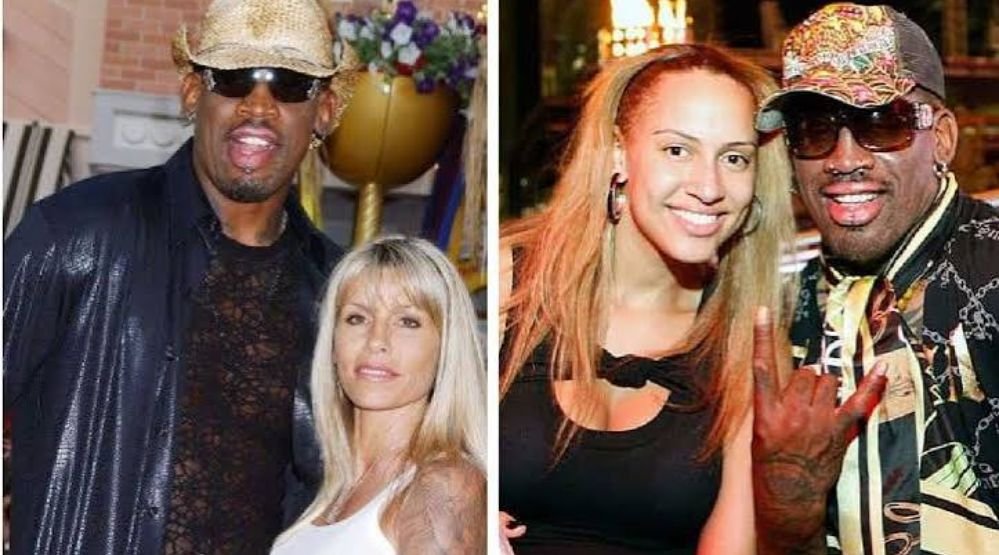
The Marriage That Lasted 82 Days and a Decade of Aftermath
They married in September 1992 — reportedly on Alexis’s fourth birthday. The symmetry of that choice is either romantic or revealing depending on how you choose to read it. Eighty-two days later, Annie filed for divorce.
The grounds she stated, both in court documents and publicly over the years, were serious. Physical abuse. Repeated infidelities. Rodman having given her a sexually transmitted disease. She alleged he pressured her into multiple abortions during their relationship. She also said he stopped her from working by promising financial support and then failed to deliver. These are significant claims. The sports press of 1993 treated them largely as an unfortunate coda to a story that was really about Rodman’s mental state — and indeed, in February 1993, not long after the divorce, Rodman was found in his car in a parking garage with a loaded rifle. He later described in Bad As I Wanna Be that he had been contemplating suicide.
Here is where coverage has, for thirty years, done something quietly unfair. The narrative of Rodman’s 1993 crisis — the spiral, the suicide attempt, the reinvention — gets framed as a story about his pain, his loss, his transformation. Annie Bakes is largely absent from that framing even though she was living through the same period with his child, the aftermath of the abuse she described, and a just-finalized divorce from a man the entire sporting world was about to fall in love with. Her crisis doesn’t get a chapter. His does.
Look, I’m not saying Rodman’s suffering wasn’t real. The evidence is that it was. But the habit of treating his pain as the meaningful narrative and her documented claims as background noise is a choice, and it’s worth naming.
The Book Nobody Actually Read
In 1997, Annie Bakes published Worse Than He Says He Is: My Walk on the Wild Side with Dennis Rodman. It was also released under the title White Girls Don’t Bounce. The book came out a year after Bad As I Wanna Be had spent twenty weeks on the New York Times bestseller list. The timing is significant: Rodman’s autobiography was a cultural event. It generated magazine profiles, talk show appearances, a famous promotional stunt where he showed up in a wedding dress at a bookstore. The book’s title itself — “Bad As I Wanna Be” — positioned his confessions as self-empowerment. Rodman got to frame himself as the protagonist of his own disorder.
Worse Than He Says He Is is, in the title alone, a direct argument. It doesn’t position Annie as the victim seeking sympathy. It positions her as the corrective — the person who has documentation that the performance Rodman sold the public wasn’t the full story. The title is actually a smart piece of framing that most coverage, when it mentions the book at all, misses entirely.
The book received some attention, largely because Rodman at that moment was inescapable. It did not make the bestseller list. It is out of print. You can find it on secondary markets. The cover photographs, depending on which edition, suggest a book aimed at the same audience that was reading celebrity-adjacent tell-alls in the late 1990s. But the content, based on what Annie disclosed across interviews and what reviewers noted at the time, was specific and serious. She wasn’t selling tabloid entertainment. She was building a documented account of behavior that had direct consequences for her health, her finances, and her daughter.
That book deserved to be treated as primary testimony. It was treated as a celebrity divorce memoir. There’s a meaningful difference.
The Chicago Tribune, 1997, and the Detail About Alexis
This one genuinely bothers me every time I think about it. In 1997, Annie Bakes gave an interview to the Chicago Tribune — the paper of record for the city where Rodman was then winning championships with Michael Jordan. She told the reporter that Alexis, then eight years old, was in anger management therapy. She said her daughter had hurt another girl during a basketball game and when asked why, Alexis had said: “Because my dad would do it.”
Then Annie said this: “Alexis shows a lot of anger right now and she is holding it against me that I left Dennis.”
Read that twice. She is describing a child in psychological distress. She is describing herself as the person that child is blaming, even though she left to protect both of them. She is doing this in a newspaper interview in 1997 while Dennis Rodman is appearing on magazine covers wearing nail polish and collecting championship rings and selling out arenas.
Nobody wrote a long piece about that Tribune interview. It was a parenthetical in a dozen different profiles of Rodman. The fact that his daughter was in therapy for anger management because she had internalized his behavior — that’s the actual consequence of the “bad boy” myth. Annie Bakes handed a reporter a window into it. The window got closed.
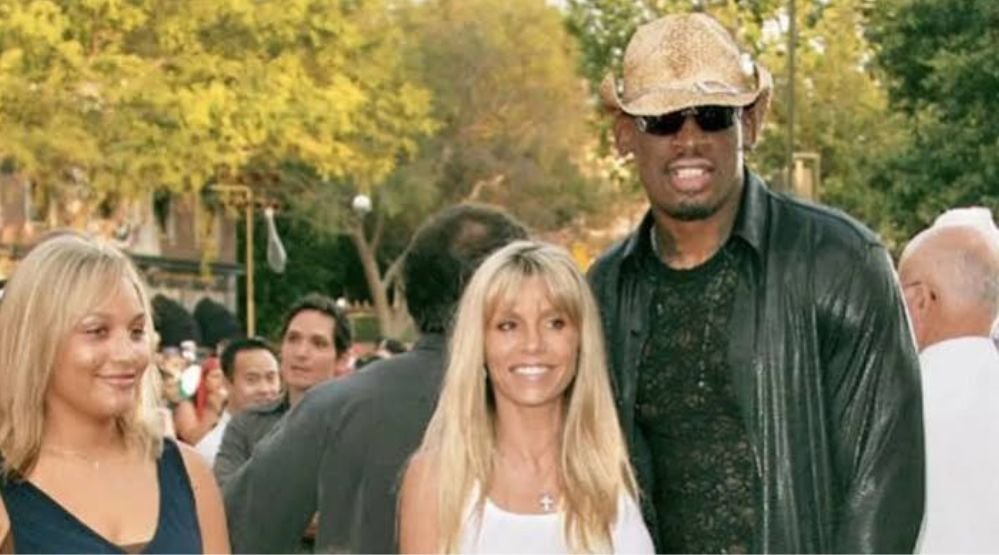
The Publicity-Hound Counter-Narrative
Here’s where I’ll complicate things slightly, because fairness matters even when you’re frustrated. Rodman’s counter-framing of Annie was not nothing. In his later autobiography, I Should Be Dead by Now, he described Annie as a “publicity-hound ex-wife” and claimed she had refused to allow Alexis to appear on the Oprah Winfrey Show unless she herself was included. The Oprah incident is documented — Rodman did break down on the show in 1996, and the attempted Alexis reunion apparently fell apart.
Whether that makes Annie a publicity hound or a mother trying to maintain control over her child’s public exposure is genuinely a matter of interpretation. Both things can be true: she wanted Alexis’s wellbeing protected, and she also wanted to be in the room. Those aren’t mutually exclusive and they’re not evidence of bad character. But Rodman’s framing got amplified by a sports press that was deep in love with his persona, and Annie’s version got pushed further to the margins.
Let’s be honest about something else. Rodman also said, in accounts surrounding the paternity and divorce period, that Annie had essentially wanted a payday. He accused her of having children to secure financial support. This is a claim that has been repeated in sports media contexts without much scrutiny. The documented record — a young woman raising his child largely alone, filing for child support, alleging abuse and STDs — does not obviously support the gold-digger framing. It supports the framing of a person trying to secure resources for a child whose father was very wealthy, very absent, and publicly accusing her of being mercenary for noticing.
The asymmetry of who got to define who in this story is not subtle.
What Actually Happened to Alexis, and What It Tells You
Alexis Rodman grew up, got married, had a son named Vincent in 2017. Dennis Rodman announced it on Twitter. In 2013, Rodman revealed on Oprah’s follow-up program that he had recently met Alexis “for the first time in years” and that she was beginning to express interest in becoming his daughter again. He called her “a really beautiful person.”
And maybe she is. And maybe that reconciliation is genuine. But the fact that a child spent years estranged from a father who was simultaneously being celebrated as a cultural legend, while her mother was being dismissed as a “publicity hound” for telling the truth about what that man was like to live with — that deserves to be stated plainly.
Annie Bakes raised Alexis. She did it through a contentious divorce, through the period of public dismissal, through Alexis’s anger management issues, through all of it. Rodman got the tattoo of Alexis on his forearm. Annie did the actual work. Then Alexis reconnects with her famous father and the narrative becomes one of reconciliation and beauty. That’s not wrong. But it also isn’t the full story, and Annie Bakes doesn’t appear in it except as context.
The Information Problem
I want to pause here and acknowledge something uncomfortable about the research process for this essay. The majority of current articles about Annie Bakes are SEO content-farm pieces that recycle the same three facts, add fabricated details (some sources say she was born in Massachusetts, others Pennsylvania; some list the book publication year as 1997, others as various dates; net worth estimates range from nominal to multi-million with zero sourcing), and confidently assert things like “the book reportedly earned a six-figure publishing deal” with no citation.
The actual primary sources on Annie Bakes are few but meaningful. The 1989 Deseret News paternity item. The 1997 Chicago Tribune interview. The Essentially Sports reconstruction of her quotes about Rodman’s parenting failures. The Sports Rush coverage of the Oprah incident. Her actual book, which is out of print and hard to obtain. That’s roughly the documented record.
Everything else — the confident assertions about her current happy marriage to a police officer, her advocacy work, her net worth — is secondary at best and fabricated at worst. What you notice when you map this out is that the actual Annie Bakes, the one with documented quotes and dated primary sources, is a much more precise and credible figure than the vague inspirational narrative the content mills have built around her. The real Annie Bakes was specific, named her sources, gave interviews to the Chicago Tribune on the record, filed legal documents in Los Angeles Superior Court. The fake Annie Bakes is a vague “former model and author who moved on and found peace.” One of those versions deserves more respect.
Personal Judgment
Here it is: Annie Bakes told the truth, in public, with her name attached, at a time when telling the truth about a beloved NBA champion carried real professional and social costs. She had the receipts — court documents, a published memoir, on-record interviews with major papers. She was dismissed, reframed as a gold digger, called a publicity hound, and gradually submerged under decades of celebratory coverage of the man she had described.
The coverage she got was not commensurate with the coverage she deserved. This isn’t a story that needs a villain, but it does need honesty about how the system worked: the sports press protected the athlete’s narrative, the celebrity press turned everything into a colorful story of excess, and the woman with the documentation got filed under “troubled ex-wife.” The fact that Alexis eventually reconciled with her father doesn’t retroactively make the childhood years Annie described untrue. The fact that Rodman later cried on Oprah about missing his daughter doesn’t change what Annie said he did during the years he wasn’t there.
You can admire Dennis Rodman as a basketball player. Most people who followed the NBA in the 1990s do. You can also acknowledge that Annie Bakes said very specific things, with documented support, and was not believed or credited in proportion to what she produced. Both things are possible. The coverage of those years mostly chose only one.
FAQs
1. Who is Annie Bakes?
Anicka “Annie” Bakes, born February 26, 1965, in Allentown, Pennsylvania. Former model whose career was disrupted by a 1986 car accident. First wife of Dennis Rodman. Mother of Alexis Rodman. Author of Worse Than He Says He Is (1997). That’s the verified core. The rest is largely fabricated by content mills.
2. How long were Annie Bakes and Dennis Rodman married?
Approximately 82 days. They married in September 1992 and Annie filed for divorce in late 1992 or early 1993. But they’d been together since 1987 and their daughter Alexis was born in September 1988 — four years before the marriage.
3. What did Annie Bakes claim Rodman did to her?
Physical abuse. Repeated infidelity. Giving her a sexually transmitted disease. Pressuring her into multiple abortions. Convincing her to stop working by promising financial support, then failing to provide it. These claims were made in court filings, on-record interviews with major newspapers, and in her published memoir.
4. Did Annie Bakes ever file legal action against Rodman?
Yes. In June 1989 — before they were ever married — she filed a paternity petition in Los Angeles Superior Court via palimony attorney Marvin Mitchelson, seeking $7,700 a month in child support and at least $1 million plus a share of his NBA Finals earnings. That’s a primary-source document.
5. What was the title of Annie Bakes’s book?
Worse Than He Says He Is: My Walk on the Wild Side with Dennis Rodman (1997). It was also republished as White Girls Don’t Bounce. It is currently out of print.
6. What did Rodman say about Annie Bakes?
In his subsequent autobiography, he referred to her as a “publicity-hound ex-wife.” He accused her of using Alexis as a bargaining chip during the attempted Oprah reunion. He described her as pursuing financial gain. His 1996 autobiography Bad As I Wanna Be mentioned her largely in the context of his own emotional spiral and suicide contemplation after the divorce.
7. What happened to their daughter Alexis?
Alexis Rodman was born September 28, 1988, grew up with her mother, went through anger management therapy as a young child (documented in the Chicago Tribune, 1997), was largely estranged from her father for years, eventually reconciled with him, married, and had a son named Vincent in 2017. She is not a public figure.
8. Did Rodman really cry on Oprah about Alexis?
Yes. He appeared on the Oprah Winfrey Show in 1996 and became visibly emotional discussing his estrangement from Alexis. He later claimed the attempted reunion was sabotaged when Annie refused to allow Alexis on the show unless she was also included. Annie’s perspective on this was never given equal coverage.
9. Why isn’t Annie Bakes better known?
A combination of factors: the sports press in the 1990s had strong incentive to protect the Rodman narrative; her claims were categorized as a bitter ex-wife’s grievances; the celebrity memoir genre she wrote in was not taken seriously as testimony; and her book went out of print. The current information ecosystem mostly produces recycled SEO content about her rather than engagement with her actual documented record.
10. Did Annie Bakes remarry?
Multiple sources claim she is currently married to a police officer and lives in Pennsylvania. I could not find a primary source confirming this. It’s consistently reported with confidence and zero sourcing, which is characteristic of the content-farm coverage around her.
11. Is Annie Bakes’s version of events credible?
She filed legal documents in 1989. She gave named interviews to the Chicago Tribune in 1997. She published a detailed memoir with her name on the cover. At the age of eight, her daughter claimed to be attending anger management therapy. Rodman has never substantively denied the core claims — he’s countered with her motivations, not with the facts. The question of whether her version is credible has a straightforward answer: it is better documented than most celebrity accounts from that era, and was treated with substantially less credibility than it deserved.
Find fresh stories beyond the spotlight with Celebs Flare.




One Comment